
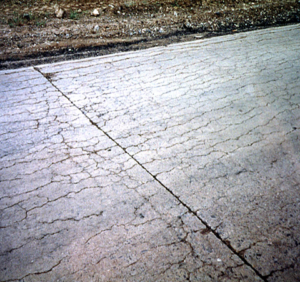
Alkali-silica reaction is a common deterioration mechanism in concrete. Some silicate minerals in aggregates react with hydroxide ions in concrete pore water, forming a gel that imbibes water and swells. The resulting stresses can cause expansion and cracking. When diagnosing ASR, the first thing to look for is the characteristic three-armed cracks. ASR gel may cause staining of the concrete near the cracks. The Federal Highway Administration has produced a handbook to aid in diagnosing ASR in the field.
Diagnosing ASR under the microscope
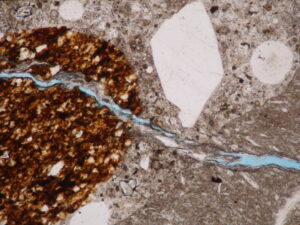
Petrographic examination can confirm the presence of ASR gel and identify the reactive minerals in the aggregate, as well as the cementitious materials in the cement paste matrix. Petrographers typically use epoxy to stabilize cracked concrete when preparing thin sections. This helps prevent artifacts of specimen preparation. Epoxy with dye makes the cracks more visible.
In the image on the right, the crack goes through both the aggregate particle and the cement paste matrix. Blue dye epoxy marks where the crack was open; the lining on both sides of it is ASR gel.
The volume and condition of the gel depend on the moisture conditions. ASR gel absorbs water and swells. It can fill existing cracks, expand them, or form new ones.
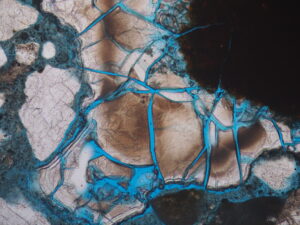
ASR normally takes five to ten years to manifest in concrete. However, damage from reactive fine aggregates may appear earlier. The last image is of shotcrete in a continuously wet environment . The reactive fine aggregate generated a considerable volume of gel, which expanded as it imbibed water.
Preventing ASR
Once you’ve diagnosed ASR, there’s not much you can do other than removal and replacement. At best, you may be able to buy a little more time. For example, it may be possible to sawcut joints that have closed due to expansion of the concrete. Or you may be able to add some posttensioning to hold it together. But these are temporary fixes. Eventually you’ll have to remove and replace it.
Your best bet is to prevent deleterious expansions in the first place. Depending on the location, you may be able to specify nonreactive aggregates. However, good sources of aggregate aren’t always available, or may come at too high a price. If that’s the case, appropriate combinations of supplementary cementitious materials can be effective. ASTM C1778 provides a comprehensive methodology for evaluating aggregates and verifying ASR mitigation measures.