
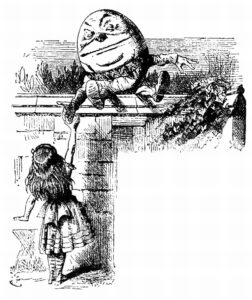
“The question is,” said Alice, “whether you CAN make words mean so many different things.”
“The question is,” said Humpty Dumpty, “which is to be master—that’s all.”
“When I make a word do a lot of work like that,…I always pay it extra.” —Lewis Carroll, Through the Looking Glass and what Alice Found There. John Tenniel illustration, public domain.
In teaching technical writing, I often quote Alice in Wonderland and Through the Looking Glass and What Alice Found There. That may seem strange until you realize that Charles Dodge, who used the pen name Lewis Carroll, was a mathematician. His children’s stories satirize the mathematics of his day. That’s why they’re so full of apt quotes and illustrations.
One peculiarity of technical writing is that it maintains a one-to-one correspondence between a term and its meaning. That is, it sacrifices variety and nuance for the sake of clarity. Humpty Dumpty’s cavalier attitude toward words and their meanings has no place in technical writing.
Reports through the looking glass
Recently I reviewed an expert report that failed to meet this standard of clarity. The writer had apparently taken Humpty Dumpty’s advice, stretching the meaning of one term to mean its opposite. He coined another term that was very similar to a common term in concrete microscopy, but used it to mean something else entirely. It made the report very confusing even to us at Beton. His client probably had no idea what it meant.
The most disturbing thing about it, though, was that the written description and interpretation were not consistent with the photomicrographs. It was as if the images had been inserted into the wrong report. They looked similar to the ones our petrographer obtained, but the written report read as if it pertained to a different project altogether. Through the looking glass indeed.