
Compared with other building materials, concrete is highly fire resistant. It doesn’t burn, it doesn’t conduct heat well, and it doesn’t emit toxic gases. It retains its strength and stiffness longer than most materials. However, a fire that burns hot enough for long enough can damage the concrete or the reinforcement. That’s why it’s important to conduct a forensic investigation of concrete exposed to fire.
Strength
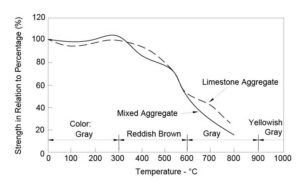
As the concrete temperature rises, free water in the pores evaporates. The resulting steam generates internal pressures that may cause cracking or spalling. In addition, the cement paste dehydrates.
Cracking can also result from differential expansion of the concrete or its components as the temperature increases. Differences between the interior and surface temperature, or between the coefficients of thermal expansion of the paste and aggregate, will cause greater expansion of some areas than of others. If the differential expansions are great enough, the resulting stresses will cause cracking.
The cumulative effects of cracking and dehydration reduce the concrete strength. However, so long as its internal temperature remains below about 300 °C (572 °F), the compressive strength remains more or less constant.
Color
Up to about 300 °C, the color of the concrete remains gray. But between 300 °C and 600 °C, it turns pink or reddish brown due to the oxidation of iron, usually from the aggregates. Above 600 °C, it turns light gray, and above 900 °C, it turns yellowish gray. These color changes are permanent, so they are useful indications of how much concrete must be removed during subsequent repairs. Because they are due to the oxidation of iron, there must be a source of iron in the concrete such as iron-bearing aggregates. That is, if you see the color change you can estimate the peak temperature of exposure, but if you don’t, look for further evidence.
Fire suppression
Damage may occur when concrete is exposed to fire. However, it’s important to consider how quickly the concrete cools afterwards. Concrete that didn’t sustain any damage in the fire itself could crack severely if sprayed with cold water from a fire hose. Rapid cooling of the surface induces thermal contraction, which is restrained by the warmer interior concrete. The tensile stresses that develop at the surface may crack the concrete. Fire suppressant foams are less destructive, as they simply smother the flames. Then the concrete cools more gradually, experiencing lower stresses.
Forensic investigation
As in any forensic investigation, it’s important to gather information before the site visit, particularly about the fire itself. What caused the fire? Where did it start? What materials burned? For how long? In some cases, color change of the concrete may be evidence of arson, as an accelerant is necessary to reach the relevant temperatures.
Other information to gather ahead of time includes the type of construction, with plans and specifications if available. And of course you must clarify with your client the questions they want you to answer.
For example, a client’s house had burned down. To rebuild, he needed the city building inspector to issue a permit. That required an engineer’s opinion that the concrete foundation was acceptable to build on. Before visiting the site, I called the building inspector to find out exactly what information he needed in my report.
At the site, concentrate on where the fire started, as that’s where it will have burned hottest and longest. In the case of the house fire, that was the garage. Because hot air rises, the exposure to the concrete foundation was minimal. The worst “damage” I found was blackening of the surface closest to where the fire started. I had no hesitation in approving it for use in the rebuilt house.
In another case, a car fire in a parking structure, the concern was the structural integrity of the prestressed concrete. The cover over the prestressing tendons had not spalled off, so we took a core near a tendon for petrographic examination. Here, too, the damage was fairly limited. Even though the fire would have been hot due to the accelerant (gasoline), it didn’t burn very long. Also, the ceiling was well above the height of the car.